Microsoft Is Down 7% in a Month, but Not One Analyst Says Sell. Wall Street Sees $630+

This post may contain links from our sponsors and affiliates, and Flywheel Publishing may receive compensation for actions taken through them.
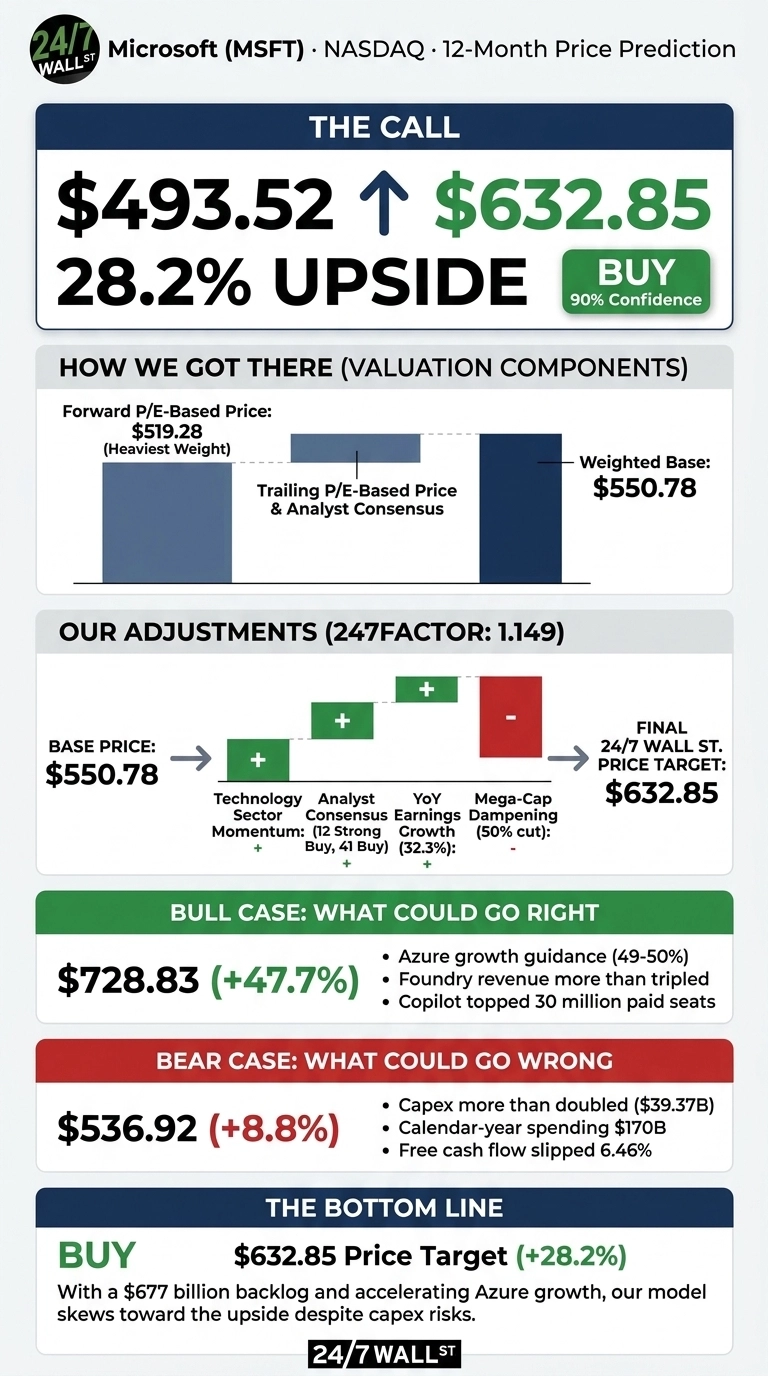
Microsoft (NASDAQ:MSFT | MSFT Price Prediction) trades at $493.52 after a 7.03% slide over the past month. Our 24/7 Wall St. price target is $632.85 over the next 12 months, which implies 28.2% upside. Our model rates the shares a buy with high confidence.
| Metric | Value |
|---|---|
| Current Price | $493.52 |
| 24/7 Wall St. Price Target | $632.85 |
| Upside/Downside | 28.2% |
| Recommendation | BUY |
| Confidence Level | 90% |

Microsoft carries 12 Strong Buy, 41 Buy, and 5 Hold ratings, with zero Sells. The consensus target of $636.12 implies 28.9% upside.

A Seventh Straight Beat Has Not Stopped the Selling
Shares fell 5.45% this week, partly as a global outage drew headlines. The stock is up just 2.9% year to date, sitting 11.6% below its 52-week high of $558.07 and 41.9% above its low of $347.87.
Fiscal Q1 2027 revenue rose 18.8%[1] to $92.28 billion, ahead of the $90.75 billion estimate. Non-GAAP EPS of $4.89[1] topped the $4.72 consensus, the seventh consecutive EPS beat. Azure grew 48%[1], and commercial remaining performance obligation reached $677 billion.

Why Bulls See $728 Within Reach
Our bull case reaches $728.83, or 47.7% upside. Management guided Azure growth to 49% to 50%[2] this quarter, with demand still exceeding supply.
Foundry has over 120,000[2] customers and revenue that more than tripled, while Microsoft 365 Copilot topped 30 million[3] paid seats. Satya Nadella said, “I’ve never been more confident in the long-term returns for our investments.”[2]

Capex Is the Risk Worth Watching
Our bear case of $536.92 still sits 8.8% above today’s price. Capex more than doubled to $39.37 billion[1], and calendar-year spending should reach about $170 billion[2]. Fiscal 2026 free cash flow slipped 6.46%[3], and Windows OEM and Devices fell 22%[1].
On the other side of the ledger, operating cash flow rose 28.73%[1] to $58 billion, and CFO Amy Hood expects Microsoft to stay free cash flow positive in FY 2027[2].
How Microsoft Compares to Alphabet and Amazon
| Company | P/E | Cloud Growth (Latest Qtr) | Latest Qtr Capex |
|---|---|---|---|
| Microsoft | 28 | 48%[1] (Azure) | $39.37B[1] |
| Alphabet | 12 | 103% | $51.36B |
| Amazon | 36 | 39% | $77.26B |
Alphabet (NASDAQ:GOOGL) competes directly through Google Cloud. Its low P/E reflects a $99 billion equity gain in Q2, and free cash flow turned negative at $9.06 billion last quarter.
Amazon (NASDAQ:AMZN) runs AWS, the main rival to Azure, but carries a richer multiple and a trailing free cash outflow of $42.4 billion. Microsoft trades at a forward P/E of 24 and still generates positive free cash flow. Against these two peers, our 24/7 Wall St. price target looks reasonable.
Microsoft’s Pullback Puts a $677 Billion Backlog in Focus
Our 24/7 Wall St. price target of $632.85 carries a buy rating and 90% confidence. What tips the scale for me is a $677 billion[1] backlog paired with accelerating Azure growth.
The bull case strengthens if Azure delivers on its 49% to 50% guide and margins hold near 65%[2]. I would turn cautious if capex outran revenue and free cash flow turned negative. On balance, our model’s range skews toward the upside.
Microsoft Price Prediction 2026-2030
Looking further ahead, here is where our model projects Microsoft could trade if current growth trajectories and market conditions hold.
| Year | 24/7 Wall St. Price Target |
|---|---|
| 2026 | $632.85 |
| 2027 | $707.85 |
| 2028 | $791.74 |
| 2029 | $885.58 |
| 2030 | $990.53 |
These projections assume Microsoft keeps executing on its AI strategy.
Faster Copilot monetization could push the stock higher than these figures, while weaker returns on AI infrastructure spending could pull it lower. All of that hyperscaler capex has to be powered, cooled, and networked by somebody, and we pulled together seven of those suppliers in a free report.
Contact [email protected] for any questions or corrections.
Vandita Jadeja is a financial publisher with over a decade of experience writing about financial topics, including investment, savings, retirement, insurance and banking. Vandita is a Chartered Accountant who loves to debunk financial concepts for readers.
Her work has appeared on sites that include The Motley Fool, InvestorPlace, and Benzinga. She covers investing and focuses on stock picks and price prediction for 24/7 Wall St.
When not looking for the next stock investment opportunity, she can be found traveling, reading, chasing sunsets and enjoying her iced latte.