Everyone Talks About Moving to Margaritaville, Nobody Talks About the Cost of Leaving
The flip-flop retirement fantasy has a price tag most buyers calculate only once, and it leaves out the three ugliest line items entirely.

This post may contain links from our sponsors and affiliates, and Flywheel Publishing may receive compensation for actions taken through them.
The pitch practically sells itself, at least in the glossy marketing materials. Sell the house up north, buy a bungalow in a themed 55-and-over community, and spend the rest of retirement in flip-flops. Jimmy Buffett’s Latitude Margaritaville developments in Daytona Beach, Watersound, and Hilton Head have built a thriving business around that exact pitch. What the sales brochures consistently omit is what it actually costs to get in, stay in, and eventually get out. This is the arithmetic that retirement planning conversations keep circling back to, and it looks very different once every line item is on the page.
What a Margaritaville Budget Actually Covers
Location drives most of the baseline cost. The two anchor communities sit in Florida, where the cost-of-living index runs at 103.4, and in South Carolina, which comes in lower at 93.7. Entry-level villas and cottages at these developments start in the mid-$300,000s for new construction, while the resale market at Daytona Beach averaged around $492,000 in mid-2026. Waterfront lots and larger single-family homes push well past $600,000, with some Daytona resales closing above $665,000 as recently as August 2026.
The Case-Shiller national index is sitting at a record 335.1, which means a retiree selling a paid-off home is essentially trading peak-price equity for peak-price destination pricing. According to the National Association of Realtors, existing home sales fell to a 3.98 million annualized pace in August 2026, the first reading below 4 million since June 2025. The sell side of this trade may take considerably longer than the fantasy version implies.
Annual carrying cost of a typical two-bedroom villa, in current dollars:
- Property taxes and homeowners insurance: $6,500 to $9,000. Florida wind and flood coverage accounts for most of that cost.
- HOA and amenity fees: $2,400 to $3,600.
- Utilities, cable, internet: about $3,600.
- Food at home, USDA moderate plan for a 55-plus couple: roughly $10,000.
- Dining, entertainment, the golf-cart-and-tiki-bar lifestyle the brochure promises: $8,000 to $12,000.
- Transportation with a replacement vehicle reserve: about $6,500.
- Healthcare before 65 for an unsubsidized ACA bronze couple: $22,000 or more.
- Healthcare at 65-plus: Medicare Part B at $202.90 a month each, a $283 Part B deductible, Medigap, Part D, and out-of-pocket, running $9,500 to $12,000 per couple.
- Home maintenance reserve at 1% of home value: $4,000 to $5,000.
- Miscellaneous, gifts, and flights back to see grandkids: about $6,000.
A couple already on Medicare lands around $70,000 to $80,000 all in. Retiring at 58 pushes closer to $85,000 to $95,000, mostly because of the ACA gap. For context, the average U.S. household spent $78,535 in 2024.
Turning That Budget Into a Portfolio Target
Social Security offsets a large portion of that spending. A couple with $2,400 and $1,600 in monthly benefits collects roughly $48,000 a year combined. The Social Security Administration officially announced the 2027 cost-of-living adjustment at 3.6% on October 14, 2026, the largest annual increase since 2023. That is a meaningful bump, adding roughly $67 to $73 per month to the average benefit check, but it still does not close a $30,000 spending gap on its own.
Target spending of $78,000 minus $48,000 in guaranteed income leaves a $30,000 portfolio draw. At a 4% withdrawal rate, that requires $750,000. At a more conservative 3.5%, which better fits a 30-year horizon with the 10-year Treasury at 4.65%, it requires roughly $857,000. Both figures sit below the Northwestern Mutual 2026 survey “magic number” of $1.46 million, though that benchmark covers total retirement savings rather than just the portfolio shortfall above Social Security. An early-retiree couple should add $200,000 to $250,000 for the pre-Medicare bridge and should watch the ACA subsidy cliff carefully, because withdrawals from taxable and traditional accounts feed modified adjusted gross income directly.
The Cost of Leaving Nobody Prices In
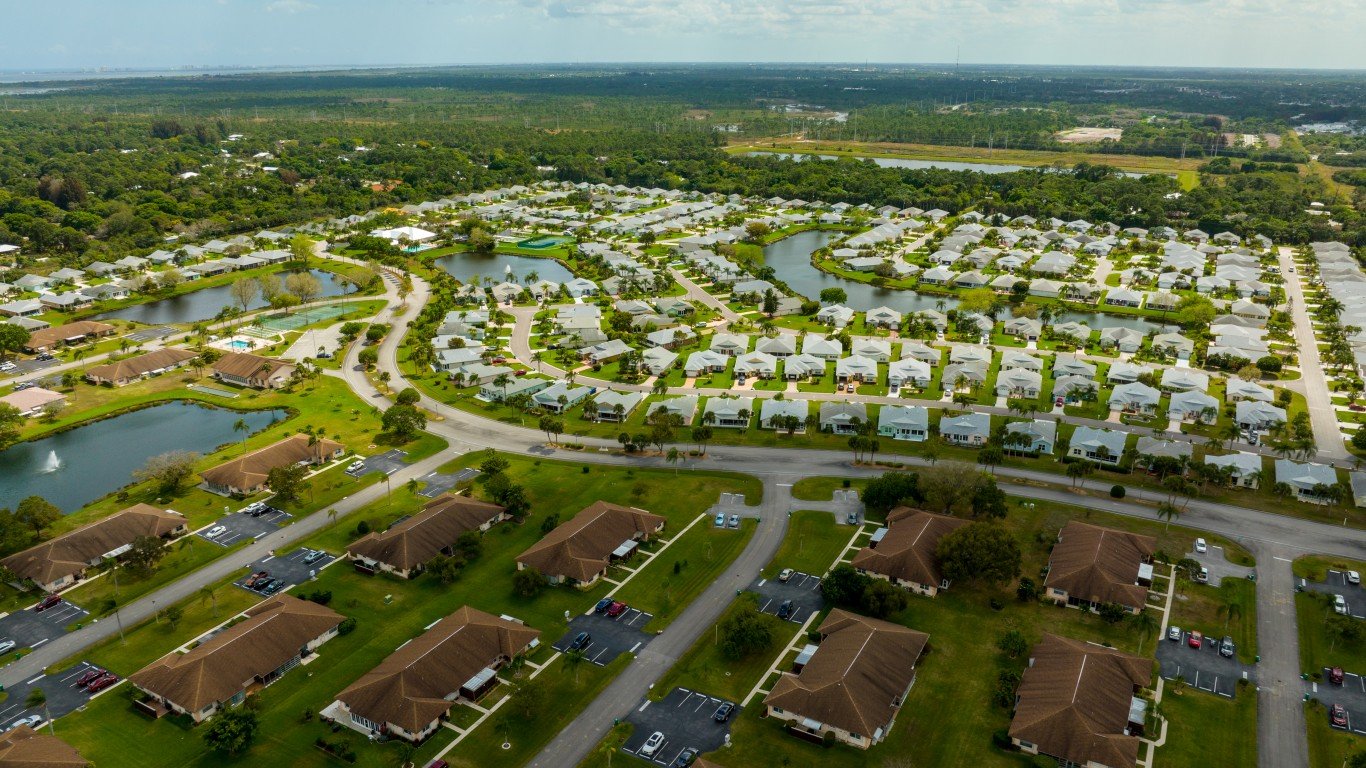
Themed 55-plus communities carry a narrower resale pool than a regular neighborhood. The buyer must be over 55, must want the branded lifestyle, and must arrive during a window when the local coastal insurance market is functional. The resale challenge is especially acute at Daytona Beach, where Minto Communities sold all 3,763 homes by May 2025, more than five years ahead of schedule. That community is now 100% resale-only, with roughly 17 to 20 active listings at any given time across a development that large. A thin market cuts both ways: sellers face fewer competing buyers, and buyers find fewer choices.
Florida’s homeowner insurance environment has pushed carriers out and doubled premiums on coastal properties in recent years. Some HOAs have faced special assessments to cover community property coverage shortfalls. A $3,000 monthly carry today can realistically become a $4,500 carry within a decade with no lifestyle change at all. That drift is already happening in many coastal Florida zip codes, making it a planning reality rather than a distant hypothetical.
Leaving is a scenario worth pricing in from the start. One spouse dies, the survivor loses a Social Security check and inherits the full carry (the survivor benefit runs on its own rules, which we walked through in a free guide to the widow’s math). A health event forces a move to assisted living, which carries a statewide median of roughly $4,750 to $5,610 a month in Florida, according to 2026 cost-of-care data, with premium coastal facilities running $6,800 or more. None of those costs qualify as a covered Medicare benefit.
Selling into a soft resale market, a coastal insurance crunch, and an age-restricted buyer pool is where the flip-flop budget breaks. The NAR’s August 2026 report showed sales falling 2% month over month to that 3.98 million annualized rate, below both the July pace and the 4 million threshold not breached since June 2025. That kind of buyer environment thins the resale queue even further for communities with a narrow eligible-buyer definition.
Florida ranks 4th and South Carolina 33rd on the 2025 State Tax Competitiveness Index, so the real pinch point for this scenario is insurance and HOA cost drift rather than state income tax on withdrawals. A realistic target for a couple who wants this scenario to hold together, cushion included, sits closer to $1.1 to $1.3 million invested near a 60/40 mix, drawing 3.5% to 4%, with Social Security claimed strategically so the surviving spouse keeps the larger check. That is the version where the flip-flops stay on for thirty years.
Editor’s note: This version updates the 2027 Social Security COLA from an estimate of 3.5% to 3.6% to the officially confirmed 3.6% figure announced by the Social Security Administration on October 14, 2026, and adds context on the August 2026 existing home sales report showing the annualized pace fell below 4 million for the first time since June 2025.
Contact [email protected] for any questions or corrections.
David Beren has been a Flywheel Publishing contributor since 2022. Writing for 24/7 Wall St. since 2023, David loves to write about topics of all shapes and sizes. As a technology expert, David focuses heavily on consumer electronics brands, automobiles, and general technology. He has previously written for LifeWire, formerly About.com. As a part-time freelance writer, David’s “day job” has been working on and leading social media for multiple Fortune 100 brands. David loves the flexibility of this field and its ability to reach customers exactly where they like to spend their time. Additionally, David previously published his own blog, TmoNews.com, which reached 3 million readers in its first year. In addition to freelance and social media work, David loves to spend time with his family and children and relive the glory days of video game consoles by playing any retro game console he can get his hands on.