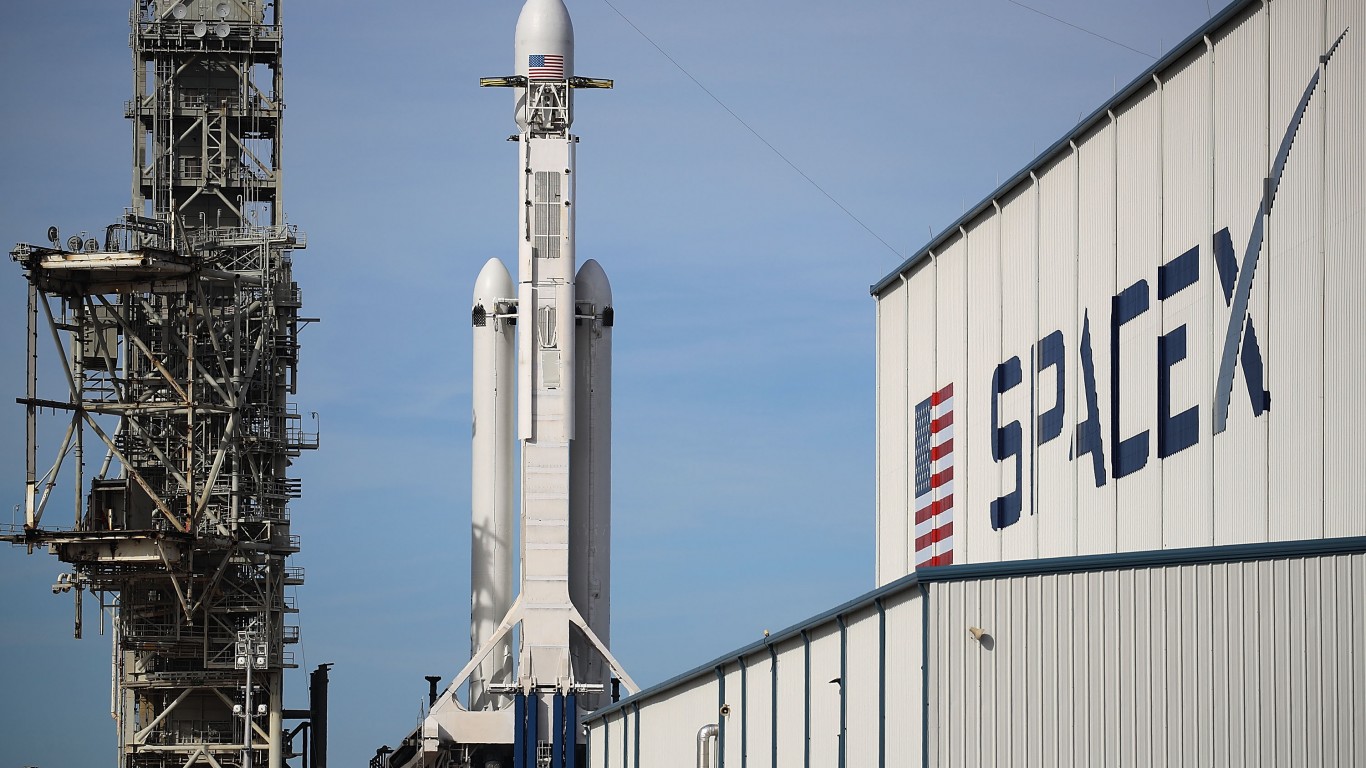
One-Fifth of SpaceX Revenue Comes From Uncle Sam: The Defense Contractors That Should Worry
SpaceX’s S-1 just handed legacy defense investors a number they cannot ignore. And you can bet they won’t. In 2025, roughly one-fifth of SpaceX revenue came from U.S. federal agencies, primarily NASA, the Department of War, the General Services Administration,…

This post may contain links from our sponsors and affiliates, and Flywheel Publishing may receive compensation for actions taken through them.
SpaceX’s S-1 just handed legacy defense investors a number they cannot ignore. And you can bet they won’t.
In 2025, roughly one-fifth of SpaceX revenue came from U.S. federal agencies, primarily NASA, the Department of War, the General Services Administration, and certain Intelligence Community agencies, focused on launch services, spacecraft development, satellite deployment, and artificial intelligence products. SpaceX is “almost always the prime contractor” on those government contracts, and its launch deals are firm fixed-price with milestone-based payments.
The math is uncomfortable for the incumbents. SpaceX generated $4.69 billion in Q1 2026 revenue with $1.13 billion in Adjusted EBITDA, and its government share is now structurally large enough to reshape who wins the next decade of launch, satellite, and orbital compute dollars. Here are the five publicly traded contractors with the most to lose, ranked by direct overlap with SpaceX’s federal footprint.
1. Boeing (BA)
Boeing (NYSE:BA | BA Price Prediction) sits at the bullseye. Its Defense, Space & Security segment houses the Space Launch System, the troubled Starliner crew capsule, and the United Launch Alliance joint venture with Lockheed, all three competing head-on with Falcon, Dragon, and Starship economics. Defense, Space & Security posted $7.60 billion in Q1 2026 revenue, up 21%, with operating earnings of $233 million. CEO Kelly Ortberg said Boeing is “supporting our customers with inspiring missions like Artemis II.” The market is unconvinced. Shares are up just 2% year-to-date, and a recent r/wallstreetbets thread explicitly pitched “a justification for SpaceX’s IPO valuation by looking backwards” against Boeing. If reusable Falcon economics permanently undercut SLS per-launch costs, Boeing’s space portfolio is the most exposed asset in the group.
2. Northrop Grumman (NOC)
Northrop Grumman (NYSE:NOC) is the only prime where Space Systems actively shrank. Space Systems revenue fell 3% to $2.48 billion in Q1 2026, hit by a $71 million unfavorable EAC adjustment on the GEM 63XL program tied to a launch anomaly and the Next Generation Interceptor wind-down. GEM 63 solid rocket motors power ULA’s Vulcan, the very platform Falcon 9 has been eating alive on price. Northrop won a slice of the SDA Tranche 3 Tracking Layer, but Starshield is the direct rival. CFO John Green acknowledged that “In the Space segment, first quarter sales and operating income were down compared to the prior year.” Shares are down 3% YTD and 16% over the past month.
3. L3Harris Technologies (LHX)
L3Harris Technologies (NYSE:LHX) is pivoting. Space & Mission Systems is the largest segment at $2.99 billion in Q1 2026, up 24%, but management is divesting the Space Technology disposal group, including Space Propulsion and Power Systems product lines, and pursuing a Missile Solutions IPO. CEO Christopher Kubasik framed the strategy as “Trusted Disruptor.” The plan: shed assets that compete with SpaceX engines and double down on classified ISR and munitions. Shares are up 6% YTD and 36% over the past year, suggesting investors are rewarding the retreat.
4. Lockheed Martin (LMT)
Lockheed Martin (NYSE:LMT) owns Orion, the only crew vehicle currently certified for deep space, and co-owns ULA with Boeing. Space revenue grew 7% to $3.43 billion in Q1 2026, roughly 19% of total quarterly revenue, mirroring SpaceX’s own one-fifth government mix. CEO Jim Taiclet sounded almost relaxed about new entrants: “We welcome competition. We welcome other people’s money and other people’s talent into this endeavor with us or in competition with us.” The company is expanding its venture fund toward $1 billion. Q1 EPS of $6.44 missed the $6.70 consensus, and free cash flow swung to negative $291 million.
5. RTX (RTX)
RTX (NYSE:RTX) is the most insulated of the group. Raytheon’s space-based sensors and missile defense pieces overlap with Starshield, but the core business is Patriot, Tomahawk, GTF, and the F135 engine, none of which SpaceX builds. Q1 2026 revenue rose 9% to $22.1 billion, adjusted EPS of $1.78 beat the $1.52 consensus, and free cash flow jumped 65% to $1.31 billion. CEO Chris Calio raised full-year guidance, saying RTX delivered “a very strong start to 2026 with organic sales and adjusted operating profit growth across all three segments.”
The Bottom Line
Every prime on this list is becoming a software and AI company or watching market share leak to one that already is. SpaceX’s vertical integration of launch, satellites, and now xAI compute compresses the addressable market for any contractor that still treats space as a cost-plus engineering services business. If you believe reusable launch economics and orbital AI compute are durable advantages, the ranking above is your exposure map. If you think framework contracts and classified backlogs insulate the incumbents, RTX and Lockheed’s munitions ramps are the counter-thesis. The S-1 disclosure put a number on a fight that was already underway.
Contact [email protected] for any questions or corrections.
I've been writing about stocks and personal finance for 20+ years. I believe all great companies are tech companies in the long run, and I invest accordingly.