Prediction: Where Will Webull Stock Be in 5 Years?
Webull just posted 104% volume growth while its stock sits 45% below where it started the year, and a handful of catalysts could either close that gap dramatically or prove the skeptics right.

This post may contain links from our sponsors and affiliates, and Flywheel Publishing may receive compensation for actions taken through them.

Webull (NASDAQ:BULL | BULL Price Prediction) is one of the most polarizing fintech names on the market. The company runs a global brokerage that just posted $261 billion in equity notional volume, up 104% year over year, while adding new products from crypto to prediction markets to a European Economic Area license.
Yet the stock trades at $7.26, down 45.54% over the past year. Can Webull shares reach $30 within five years, by 2031?

Why Webull Shares Are Stuck Despite Record Trading Volume
The disconnect is real. Revenue growth is accelerating, but the market is punishing profitability. Q1 2026 delivered $159.93 million in revenue, up 36% year over year, yet Webull swung to a GAAP net loss of $21.72 million. Operating expenses climbed 68% while revenue grew 36%, with marketing spend more than doubling. Adjusted operating profit fell to $14.82 million from $28.66 million from a year ago.
The stock is down 6.56% year to date and 3.71% over the past week. With a beta of 0.554, this is a patience story. Investors want to see whether the company can grow revenue faster than costs, and Q1 didn’t deliver that.

Wall Street Sees 70% Upside. Our Model Sees 41%.
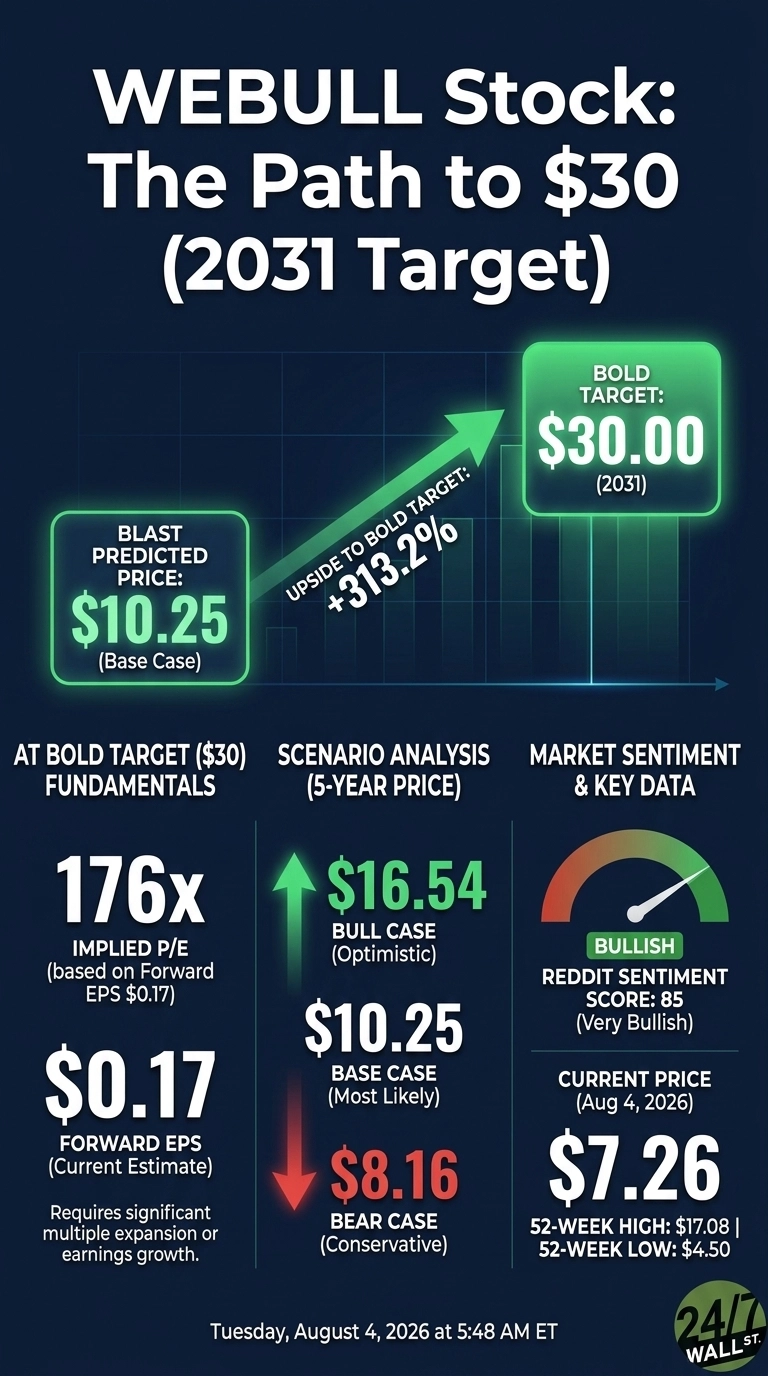
All three analysts covering Webull are unanimous, with a consensus target of $12.33. Our 24/7 Wall St. model lands at a more conservative $10.25 base case with 41.19% upside, an optimistic $16.54, and a confidence score of 0.9. Wall Street may be too cautious on the long tail.

The Path to $30 Per Share by 2031
Reaching $30 from today’s price of $7.26 requires a gain of 313.2%. With forward EPS of $0.17, a price of $30 implies a forward P/E of 176x. Our base case of $10.25 already implies 45x means the bold target requires 131x of additional multiple expansion on today’s earnings. That shrinks in one way: EPS growth.
If Webull grows forward EPS to $1 by 2031, $30 becomes a 30x forward multiple, entirely reasonable for a fintech scaling globally. Key catalysts are the Vega AI Analyst rollout, the European Economic Area license, and the Webull Premium subscription base of 102,000.
CEO Anthony Denier told investors on the Q1 call: “The demand from sophisticated, self-directed investors, including institutional and B2B clients, has never been greater.” The primary risk is PFOF regulation, which could impair the core revenue engine overnight.
Where Webull Trades Today vs Its Earnings Power
At $7.26 against forward EPS of $0.17, Webull carries a forward P/E of 43x, roughly in line with Alpha Vantage’s 37x. Shares sit 28% below the 52-week high of $17.08 and well above the $4.50 low.
That’s a compressed setup for a company growing revenue in the mid-40s and building an international footprint across 15 markets with 35 licenses. The valuation looks expensive on trailing numbers and cheap on forward earnings power, if operating leverage from Q3 2025 returns.
Is $30 Realistic? Here’s My Take
Reaching $30 by 2031 requires a 313.2% gain and meaningful EPS growth to justify the multiple. That’s a stretch, not a layup.
Three things need to break right. First, Q3-style operating leverage must return, where revenue grew 54% against 18% expense growth. Second, international funded accounts (already 790,000-plus outside the US) need to compound. Third, Vega and the B2B clearing platform need to generate margin, not just headlines. A PFOF ban or escalating China-related inquiries would derail the thesis. We’ve outlined the blueprint for how Webull could reach $30 in 2031.
Contact [email protected] for any questions or corrections.
Vandita Jadeja is a financial publisher with over a decade of experience writing about financial topics, including investment, savings, retirement, insurance and banking. Vandita is a Chartered Accountant who loves to debunk financial concepts for readers.
Her work has appeared on sites that include The Motley Fool, InvestorPlace, and Benzinga. She covers investing and focuses on stock picks and price prediction for 24/7 Wall St.
When not looking for the next stock investment opportunity, she can be found traveling, reading, chasing sunsets and enjoying her iced latte.