Comfortable Off-Grid Living Costs More Than Most People Think. A Lot More.
The off-grid dream usually starts with a simple idea: escape the bills, escape the crowds, and become more self-reliant. Many people picture a house in the woods powered by the sun, fed by a well, heated by wood, and insulated…

This post may contain links from our sponsors and affiliates, and Flywheel Publishing may receive compensation for actions taken through them.
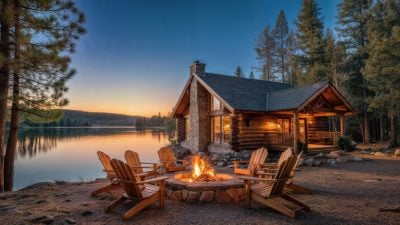
The off-grid dream usually starts with a simple idea: escape the bills, escape the crowds, and become more self-reliant. Many people picture a house in the woods powered by the sun, fed by a well, heated by wood, and insulated from the rising costs and frustrations of modern life. In that version of the story, living off the land looks cheaper than living in suburbia.
The reality depends on what kind of off-grid life you want. If you are willing to haul water, live in a cabin, cut your own firewood, and accept a noticeably less convenient lifestyle, the costs can be manageable. Most retirees, however, are not looking for hardship. They want hot showers, reliable internet, dependable power during winter blizzards, modern healthcare access, comfortable indoor temperatures, and the same level of convenience they enjoyed in town.
Recreating a suburban lifestyle in the wilderness is possible. It is also far more expensive than most people expect. Once you price the land, house, solar system, batteries, backup power, water infrastructure, insurance, healthcare, and long-term maintenance, the off-grid dream starts looking less like a way to save money and more like a premium lifestyle with a different view out the window.
Pricing the land and the build
North Idaho sounds like paradise to off-gridders. But Bonner, Boundary, Kootenai, and Shoshone counties, are no longer cheap frontier. Twenty to forty acres of buildable land with south-facing aspect, road access, and drillable groundwater realistically runs $250,000 to $450,000. A comfortable 2,200 to 2,500 square foot off-grid home with ICF or SIP construction, triple-pane glazing, standing-seam metal roof, and passive solar design runs $550,000 to $850,000 turnkey at today’s material prices.
Off-grid utility systems are underestimated: a whole-house solar array sized for January in the Selkirks, paired with a lithium battery bank for a week of overcast, plus a propane or diesel generator totals $90,000 to $140,000 installed. A drilled well with submersible pump, pressure tank, and buried 1,500 gallon cistern runs $35,000 to $55,000. A state-permitted septic with drain field is $15,000 to $25,000. A wood stove, backup propane boiler, and 1,000 gallon buried propane tank add $40,000 to $60,000. Call the all-in build $1.1 million to $1.5 million before furnishing.
Annual living costs
An upper-income couple living this lifestyle spends roughly $110,000 a year in current dollars:
- Property taxes on a $1.2 million parcel run $5,000 to $7,000.
- Homeowners insurance has tripled in the region; a defensible-space-compliant policy now costs $6,000 to $10,000.
- Pre-Medicare healthcare for a couple in their late 50s on a silver ACA plan runs $28,000 to $36,000 including out-of-pocket maximums.
- Food via the USDA Liberal plan for two adults runs near $14,000 with garden and hunting supplements.
- Propane, diesel, and cordwood run $5,000 to $7,000.
- Starlink Performance plus satellite SOS and VHF radio costs about $2,400.
- Two vehicles, a tractor, and a UTV carry roughly $12,000 a year in reserves.
- System reserves for lithium batteries (12 to 15 year cycle), well pump (15 years), septic pumping (every three years), roof (30 years), and generator rebuilds require $15,000 annually.
- Idaho taxes retirement withdrawals at a flat rate of 5.695% with no special exclusion for IRA distributions, so federal and state combined on a $120,000 gross draw is roughly $18,000 to $22,000.
Portfolio requirements
Take the $110,000 spending target and gross it up for taxes to about $135,000 a year of withdrawals. If both spouses claim Social Security at full retirement age, current SSA averages put a dual-earner couple near $62,000 combined in today’s benefit dollars. That leaves a $73,000 portfolio gap, which at a 4% withdrawal rate implies about $1.83 million invested.
Early retirement at 55 is harder. A couple must fund the entire $135,000 themselves for roughly twelve years before Social Security, requiring a tighter 3.25% to 3.5% withdrawal rate across a 35-year horizon. That math points to $3.8 million to $4.2 million invested, separate from land and house. Bridge income typically comes from a treasury ladder covering five to seven years of spending, a dividend-equity sleeve for the back half, and a cash reserve for one full winter. Five-year treasuries near 4.17% and ten-years at 4.46% make that ladder productive right now.
You need roughly $1.3 million liquid to build, plus a $3.8 million to $4.2 million portfolio to retire at 55, or a $1.8 million portfolio if you wait until 67. Call the early-retirement total $5.3 million in invested and built assets. Traditional retirement is closer to $3.1 million.
Hunting, timber, and water rules
Idaho is permissive about what you can do on your own ground. After six months of residency, resident hunting and fishing licenses cost roughly a tenth of nonresident prices, and an elk tag plus deer tag plus year-round fishing meaningfully offset protein costs. You can harvest timber on your own land without a commercial permit as long as you do not sell it across state lines. Anything over five acres of harvest triggers a forest practices notification with the Idaho Department of Lands. Idaho is a prior-appropriation state: a domestic well serving a single household for indoor use and up to half an acre of irrigation is exempt from water-right permitting, but irrigation of a pasture or stock pond requires a water right, and senior rights upstream can curtail you in a dry July.
What breaks the plan
Off-grid budgets fail on insurance and medical proximity. North Idaho has moved into a tier where several national carriers stopped writing new policies. Survivors require defensible space inspections, and premiums have risen faster than general CPI. If you cannot insure the house, the lender will not finance the build. Price a $7,500 premium growing at 8% a year.
The nearest Level II trauma center to most of Bonner and Boundary counties is Kootenai Health in Coeur d’Alene, a 60- to 90-minute drive in good weather. A serious cardiac or stroke event past the golden hour has a different outcome at that distance. Build into the plan a Life Flight Network membership ($149 per household), satellite SOS service, trauma and emergency supplies, and periodic first-aid training at roughly $500 to $1,000 per year. And plan for possible relocation to closer hospital care in your mid-70s, because it is the single most common reason this lifestyle ends earlier than owners wanted.
What it takes
Comfortable off-grid retirement in north Idaho requires roughly $1.3 million to build, a $1.8 million portfolio if you wait for Social Security at 67, or a $3.8 million-plus portfolio if you want out at 55, all earning a blended 6% to 7% nominal return against a 3.25% to 4% withdrawal rate. You need a wildfire-insurance budget that rises faster than inflation, a medical-evacuation plan you actually fund, and an honest exit strategy for the years when distance from healthcare becomes a liability rather than a feature.
The biggest misconception is that off-grid living is a way to escape costs. In reality, comfortable off-grid living replaces monthly utility bills with private infrastructure that you own, maintain, insure, and eventually replace. The reward is independence, privacy, and a front porch that looks out over your own land rather than a subdivision. The price is that you become your own utility company, water district, and emergency-preparedness department. People who understand that tradeoff before they build tend to stay. The ones who do not often discover that self-sufficiency is less about saving money than having enough money to sustain it.
Contact [email protected] for any questions or corrections.
Drew Wood has edited or ghostwritten nine books and published more than 1,500 articles on investing, business, politics, travel, world cultures, wildlife, and earth science. He holds a doctorate and four master's degrees and has nearly 30 years of college teaching experience. His travels have taken him to 25 countries, including three years living in Ukraine.