AI CEO On CNBC: ‘We Are Replacing Junior Employees with AI.’ The Only Solution is a Tax on AI and Robots
On CNBC’s Squawk Box on June 4, 2026, Andrew Yang, CEO of Noble Mobile and founder of the Forward Party, made a candid admission about how AI is reshaping his own company and called for a sweeping change to how…


On CNBC’s Squawk Box on June 4, 2026, Andrew Yang, CEO of Noble Mobile and founder of the Forward Party, made a candid admission about how AI is reshaping his own company and called for a sweeping change to how the U.S. taxes automation. When he was asked whether companies are cutting entry-level hiring because of AI, Yang said: “The easiest people to fire are the people you haven’t hired yet. So are we replacing junior analysts and junior engineers with AI? 100%.”
The Displacement Argument
Yang’s logic starts with the capex bill. He argued that with companies projected to spend roughly $1 trillion on AI infrastructure and data centers, the only realistic source of returns is labor. “You have to get hundreds of billions of dollars in cost savings from corporates. And where is that going to come from? Headcount. It’s got to,” he said.
The scale of that spend is evident among hyperscalers. Microsoft (NASDAQ:MSFT | MSFT Price Prediction) posted $30.88B in CapEx in its most recent quarter and disclosed an AI business at a $37 billion annual run rate, up 123% year-over-year.
Alphabet (NASDAQ:GOOGL) guided 2026 CapEx to $190B, while Amazon (NASDAQ:AMZN) targets roughly $200B in 2026 CapEx. NVIDIA (NASDAQ:NVDA) reported Q1 FY2027 revenue of $81.61B (+85.2% YoY) and guided Q2 to $91B, per its SEC filing. That is the buildout Yang says must be paid for.
The Tax Proposal
Yang’s pitch is to tax AI and robots while cutting taxes on human workers. He walked through the current wedge between what a worker costs and what they receive: “If I hire a young person, I’m going to pay 7 to 10% in FICA and state unemployment and a bunch of taxes. I’m going to pay another 8-11% for their health care. You’re talking about almost half of the total money that’s getting allocated to that worker. That’s not going to the worker.”
The flip side, he argued, is that the systems doing the displacing carry no comparable burden. “AI is going to do so much work, robots are going to do so much work. And right now those companies are not going to pay meaningful taxes. So what you’re going to see is the worst of all worlds,” Yang said. He also claimed a prior U.S. retraining program for Midwest manufacturing workers had a 0% effectiveness rate, arguing that transition support needs new funding.
The Industry-Insider Angle
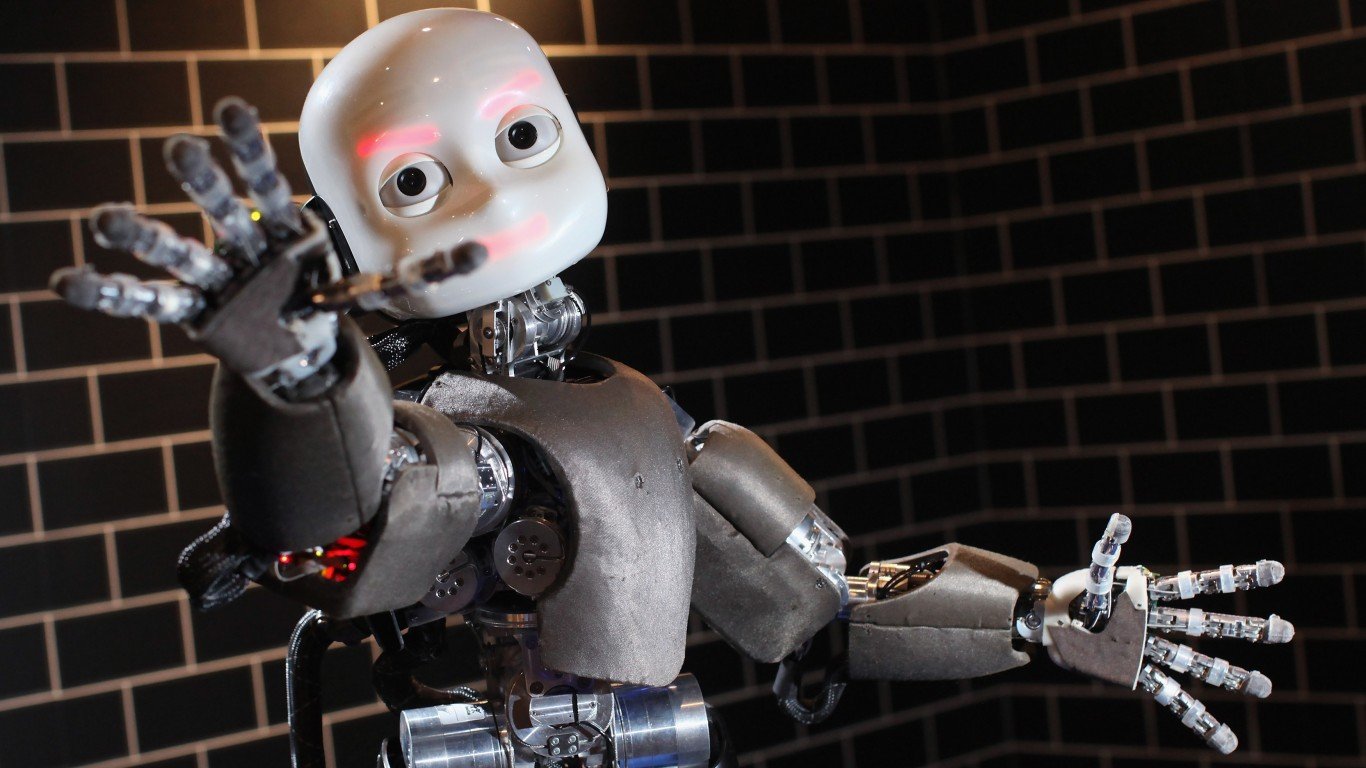
Yang anchored the idea’s credibility to an AI lab founder. “This is not just me talking. Dario Amodei, the CEO of Anthropic, said, ‘Tax us, please.’ He proposed a 3% token tax,” Yang said. An AI tax remains far from consensus and faces real practical objections around defining the tax base, global competitiveness, and who ultimately bears the cost. Tesla (NASDAQ:TSLA) is the most literal example of the robot side of the debate, with Optimus production lines being installed and Elon Musk publicly arguing the humanoid could become Tesla’s most valuable product.
Polymarket traders currently assign only a 14% probability to Optimus commercial release by year-end 2026, suggesting markets view the robot displacement question as a multi-year debate.
Why Investors Should Care
A token tax or automation levy would become a cost input across the entire AI value chain, from NVIDIA, up 52.1% over the past year, to cloud providers monetizing inference. No such tax exists today, and proposals at this stage are early and contested.
Yang is surfacing a real tension. Massive AI capex needs to pay for itself, and labor is the likely source of those savings. Whether the policy answer is an AI tax, a payroll tax cut, both, or neither remains an open question worth tracking for anyone exposed to the AI infrastructure trade.
Contact [email protected] for any questions or corrections.
Thomas Richmond is a financial writer and content strategist with 5+ years of experience covering stocks and financial markets. He has published over 500 articles focused on individual stock analysis, helping investors better understand business fundamentals, stock valuations, and long-term opportunities.
Thomas previously served as a Content Lead at TIKR, a stock research platform, where he helped scale the company’s blog to hundreds of articles per month and contributed to a weekly newsletter reaching more than 100,000 investors.
Outside of work, Thomas enjoys weight lifting and soccer.