Should You Follow Billionaire Bill Ackman Into His 2 Favorite Mag 7 Stocks?
Bill Ackman just placed two multi-billion-dollar bets on beaten-down Mag 7 giants at the same time, a move rare even for him. Whether his reasoning holds up for investors who cannot afford a multi-quarter drawdown is a different question entirely.

This post may contain links from our sponsors and affiliates, and Flywheel Publishing may receive compensation for actions taken through them.
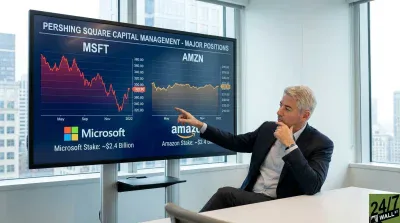
Bill Ackman’s Pershing Square began accumulating Microsoft (NASDAQ:MSFT | MSFT Price Prediction) shares in February 2026 and had built the position to roughly $2.4 billion by the end of May 2026, a stake Ackman disclosed publicly on X ahead of the fund’s Q1 13F filing.
In parallel, Pershing Square has been building a separate Amazon (NASDAQ:AMZN) position from scratch since roughly mid-2025, and Amazon now sits as the fund’s second-largest holding at approximately $2.4 billion. Here investors have two mega-cap tech names, two multi-billion-dollar bets, and an activist manager who rarely holds more than a dozen positions at once.
Microsoft (MSFT)

The Microsoft trade is the more revealing of the two. Microsoft stock is down 20.72% year to date and 24.69% over the past year, trading near $389.90 against a 52-week high of $551.05. Ackman sold Alphabet shares to fund the buy and framed the setup as a market overreaction to concerns about Azure’s durability and Microsoft’s AI positioning, calling it a core holding at roughly 21 times forward earnings.
The underlying numbers back the thesis. The company’s fiscal Q3 2026 revenue came in at $82.89 billion, up 18.3% year over year, with EPS of $4.27 beating estimates. Impressively, Microsoft’s Intelligent Cloud segment grew 30%, its Azure profit center grew 40%, and Satya Nadella disclosed the “AI business surpassed an annual revenue run rate of $37 billion, up 123% year-over-year.” Commercial remaining performance obligations nearly doubled to $627 billion, while the company’s operating margin still runs above 46%. Forward P/E of 20x on a business compounding earnings above 20% is where Ackman-style concentrated value tends to strike.
Amazon (AMZN)

The Amazon call rhymes. Amazon trades at $232.55, essentially flat over the past year despite Q1 2026 revenue of $181.52 billion, up 16.6%, and an EPS beat of $2.78 versus $1.73 expected. AWS grew 28%, its fastest pace in 15 quarters, on a base above $37 billion per quarter. Advertising ran at $17.24 billion, up 24%. Amazon’s in-house silicon effort (Graviton, Trainium, Nitro) crossed a $20 billion run rate with triple-digit growth, and OpenAI committed to roughly 2 GW of Trainium capacity beginning 2027. Value-oriented managers including David Tepper and Seth Klarman have also added to Amazon in recent quarters.
The thesis binding both trades is straightforward: the market is pricing hyperscaler AI capex as a margin risk, while the operators keep converting that spend into accelerating cloud revenue. Microsoft trades at a discount to its own five-year multiple after a drawdown. Amazon’s core retail plus AWS combination is producing GAAP earnings growth of 74.8% year over year yet the stock has gone nowhere.
For a retirement-focused investor, the takeaway is about framework rather than position sizing. Ackman runs a concentrated book and can absorb multi-quarter drawdowns; a retiree usually cannot. The useful signal is that a disciplined manager is willing to hold two of the largest companies in the world at the same time because the price finally makes sense on cash flow terms. Following him in is defensible when the entry reflects the same math: a durable franchise, forward earnings you can underwrite, and a valuation that already contains bad news.
On MSFT at roughly 20x forward earnings with Azure at 40% growth, that math holds. On AMZN, the AWS acceleration does the same work. Adopting the framework is the defensible move, but copying position sizes blindly is a mistake.
Contact [email protected] for any questions or corrections.
Chris MacDonald is a 24/7 Wall St. contributor and long-time contributor to other notable finance publications, including The Motley Fool and InvestorPlace. With an MBA in Finance, and more than a decade of experience in venture capital and the corporate finance world, Chris brings a long-term perspective to his analysis of equities and alternative assets.
His love of investing and focus on finding quality undervalued stocks is complemented by recent research into alternative assets as well. He takes a long-term approach to analyzing companies and cryptos, with a focus on directing the reader to the most sustainable and important catalysts for each respective potential investment.