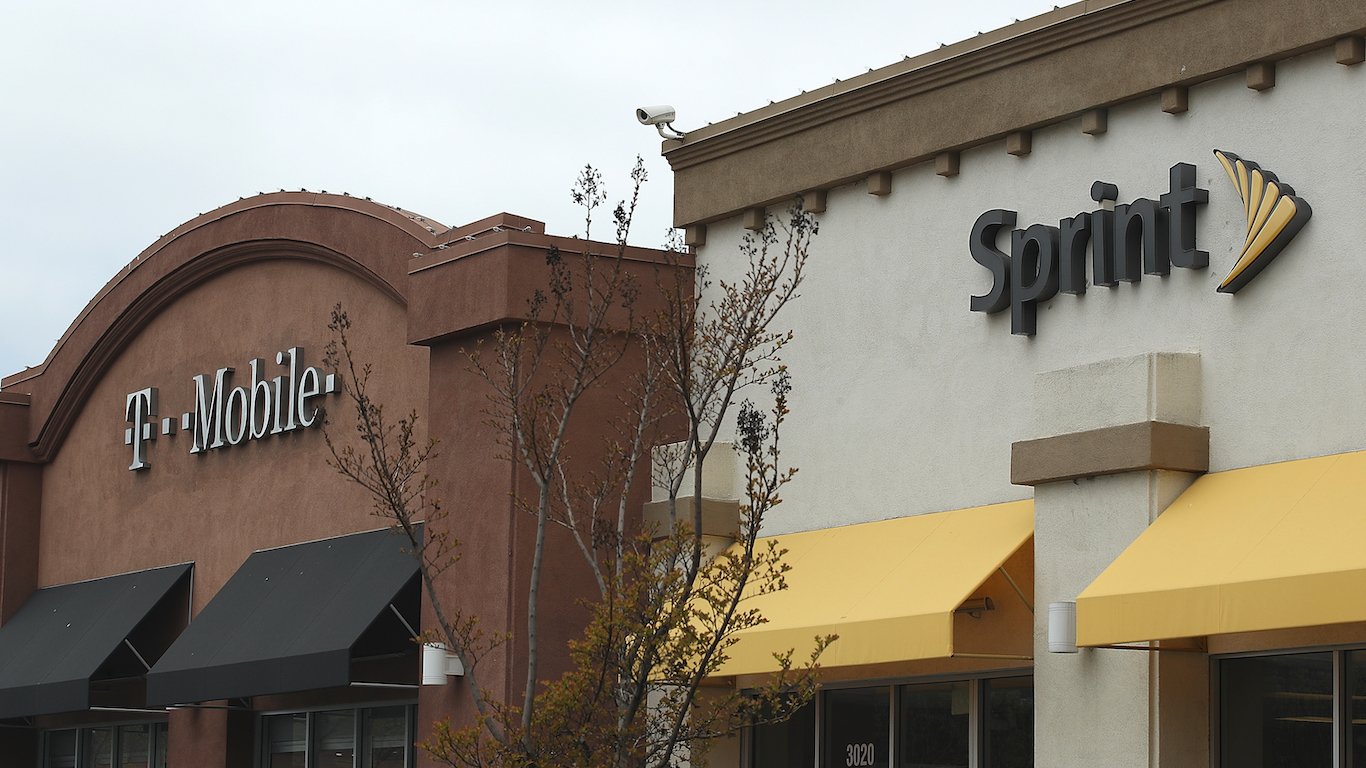
T-Mobile Merger Not Dead Yet (T, DTEGY, S, VZ, VOD, LEAP, PCS)
Yesterday’s filing by the US Department of Justice in the proposed $39 billion merger between AT&T (NYST: T) and T-Mobile may be, in the words of Winston Churchill, just “the end of the beginning.” T-Mobile’s owner, Deutsche Telekom AG (OTC:…


In fact, if history is any guide, it is more likely that a deal will be struck that allows the merger. Opposition from Sprint Nextel Corp. (NYSE: S) could be muted by the fact that the merger would leave Sprint as the only large low-cost provider in the US. A combined AT&T/T-Mobile would hold about 43% of the US mobile phone market, while Verizon Wireless would own about 34%. Verizon Wireless is a joint venture between Verizon Communications Inc. (NYSE: VZ) and Vodafone plc (NASDAQ: VOD). Sprint gets about 16% and the rest is spread among smaller players like Leap Wireless International Inc. (NASDAQ: LEAP) and MetroPCS Communications, Inc. (NYSE: PCS).
The crux of the DoJ’s complaint is the anti-competitive nature of the proposed merger. As lower-cost providers, T-Mobile and Sprint offer consumers both more choices and lower prices. A single low-cost provider with just 16% of the market is unlikely to be effective in challenging the pricing practices of either AT&T or Verizon Wireless. That’s the thinking of the DoJ.
A possible tie-up between T-Mobile and Sprint has also been raised. That combination would own about 27% of the market, enough to give it some muscle against the two bigger players. In order for such a deal to happen though, the federal government would practically have to back the deal itself. Sprint’s market cap is a tidy $11 billion or so, but there’s no way the company could put $39 billion on the table against AT&T, with a market cap of about $168 billion.
At some point, T-Mobile and Sprint, if they remain independent, will either be forced to merge or to be acquired by either AT&T or Verizon Wireless. AT&T could argue against the DoJ’s complaint that the company is merely being visionary, not rapacious.
A report from CNNMoney notes that the DoJ’s record in these kinds of cases is not particularly strong. In the past 20 years, the DoJ has thoroughly investigated just 4.4% of proposed mergers and tried to stop just 0.3%. Even then, the odds are only about even that the DoJ will prevail.
AT&T would have to pay a $3 billion break-up fee to T-Mobile if the deal falls through. If Ma Bell chooses instead to fight the complaint, its legal costs won’t exceed a fraction of that. Why not fight?
If AT&T does decide to fight, all the company’s arguments related to spectrum and network expansion are details. AT&T must be able to show that its acquisition of T-Mobile will not harm consumers either by forcing prices to rise or by stifling innovation. That’s a rough road, but not an impassable one. This merger isn’t over til it’s over.
Paul Ausick
Contact [email protected] for any questions or corrections.
Jon Ogg has been a financial news analyst since 1997. Mr. Ogg set up one of the first audio squawk box services for traders called TTN, which he sold in 2003. He has previously worked as a licensed broker to some of the top U.S. and E.U. financial institutions, managed capital, and has raised private capital at the seed and venture stage. He has lived in Copenhagen, Denmark, as well as New York and Chicago, and he now lives in Houston, Texas. Jon received a Bachelor of Business Administration in finance at University of Houston in 1992. www.247wallst.com.