The Riskiest Places to Live in America
Where in the United States do natural hazards make it riskiest to live? CoreLogic has the answer.

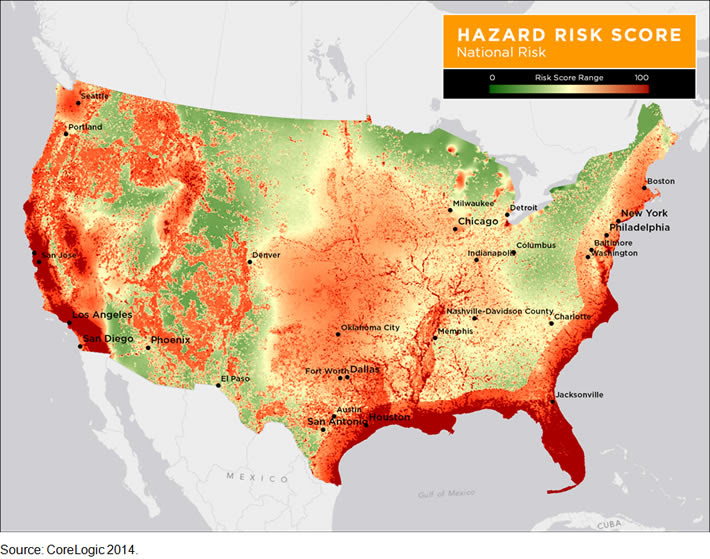
 Where in the United States do natural hazards make it riskiest to live? Based on data derived from nine natural hazards, CoreLogic has generated a Hazard Risk Score for the lower 48 states and the District of Columbia. Alaska and Hawaii were not included due to lack of data.
The nine natural hazards included are: flood, wildfire, tornado, storm surge, earthquake, straight-line wind, hurricane wind, hail and sinkhole. Scores were assigned on a scale of 0 through 100.
Here are the 10 riskiest states:
- Florida, 94.51
- Rhode Island, 79.67
- Louisiana, 79.23
- California, 75.56
- Massachusetts, 72.12
- Kansas, 69.51
- Connecticut, 69.04
- Oklahoma, 66.82
- South Carolina, 66.38
- Delaware, 65.38
The 10 least risky states are:
- Michigan, 20.22
- West Virginia, 20.67
- New York, 24.97
- North Dakota, 27.5
- Vermont, 28.31
- Pennsylvania, 28.79
- Wyoming, 30.24
- Maine, 31.64
- Ohio, 34.61
- Minnesota, 36.42
Florida’s high ranking is the result of a potential for hurricanes, storm surges, sinkholes, flooding and wildfires. Michigan’s low ranking reflects little exposure to natural hazards other than flooding. CoreLogic has prepared the following map to illustrate the hazard scores.
READ ALSO: Cities With the Most Dangerous Diets
Contact [email protected] for any questions or corrections.
Paul Ausick has been writing for 247Wallst.com for more than a decade. He has written extensively on investing in the energy, defense, and technology sectors. In a previous life, he wrote technical documentation and managed a marketing communications group in Silicon Valley.
He has a bachelor's degree in English from the University of Chicago and now lives in Montana, where he fishes for trout in the summer and stays inside during the winter.